
There’s just one catch—we might be the ones requiring surgery.
If TPTB means something to you, you should probably read this. If it doesn’t, you may have even more reason to. Is it truly possible to neuter the infamous powers that be? That is yet to be determined. Is it probable? Probably not, “but you have to do it anyway.” So why all the pessimism? What makes the task so daunting? First, we must be able and willing to recognize exactly who these mysterious powers are and how they operate. And as Walt Kelly’s Pogo so aptly put it: “We have met the enemy and he is us.” All of the possible PTB candidates have one common Achilles’ heel—this too is us, and we are legion.
Before identifying the powers that be, perhaps we should identify the powers that make TPTB possible. Almost all of us look to place the blame elsewhere, but where has that gotten us? We each have our favorite pet theory, though there is rarely any original thought involved. Maybe they’re politicians. Maybe they’re “the Jews.” Maybe they’re billionaires and multinational corporations. Maybe they’re media conglomerates. Maybe they’re tech companies and algorithms. Maybe they’re some shadowy cabal meeting beneath a volcano. Maybe the much-feared Illuminati. Maybe the NWO. Maybe they’re extraterrestrial lizard accountants receiving quarterly reports from Alpha Centauri. Maybe they’re the Lords of AI. Maybe it’s the “Father of Lies” himself.
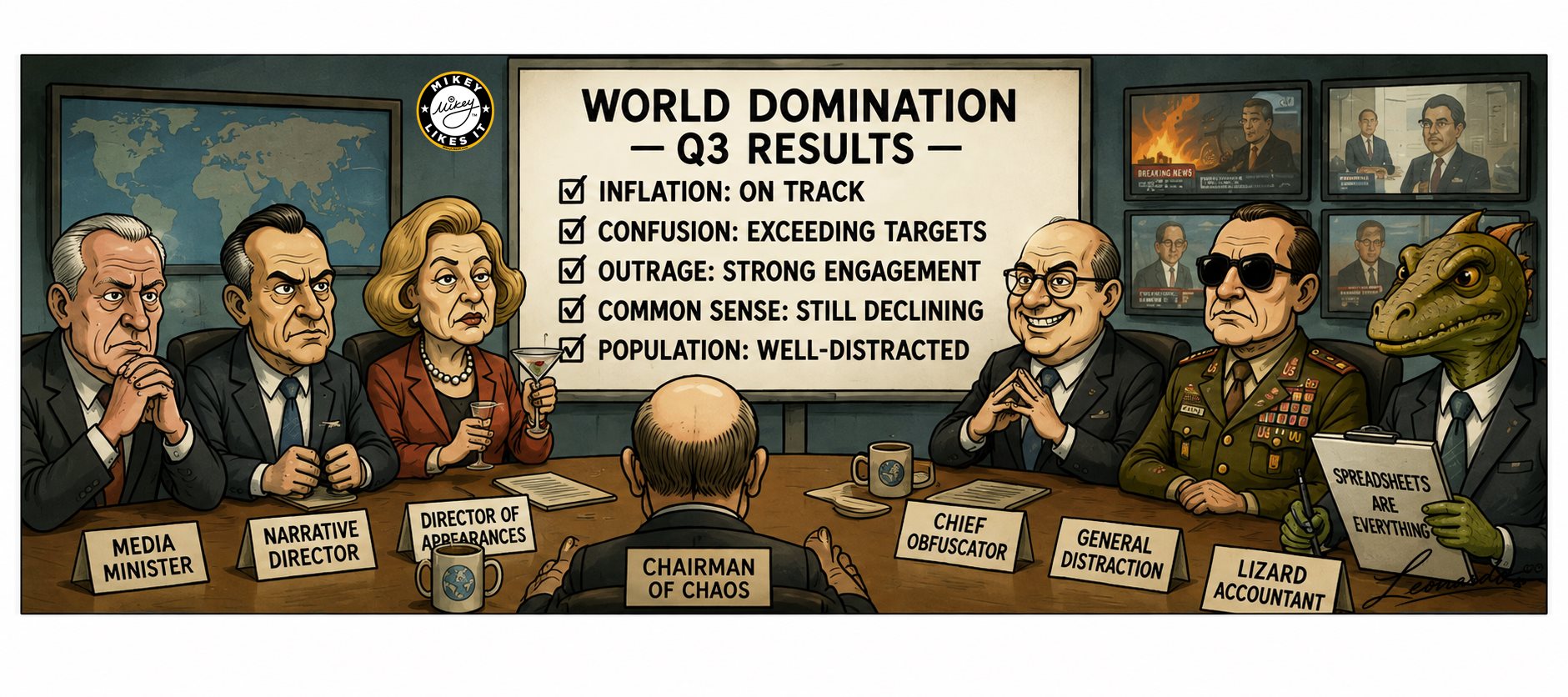
Not to beat a dead horse, but without us, the worst that those just mentioned could do would hardly be worth writing about. But what about the gatekeepers? Almost certainly there are gatekeepers. Take Alex Jones for example. Among those who can decode TPTB, he is either loved as a “watchman on the tower” or suspected by others of being a gatekeeper serving interests he ostensibly opposes—with alleged connections to Stratfor, sometimes dubbed the “Shadow CIA,” figuring into some of those suspicions. That his audience receives a relentless diet of alarming information is considerably easier to establish—Big Pharma Is Hiding This From You is one headline encountered while writing this post. Is perpetual alarm simply what keeps an audience watching and listening? Is the motive genuinely positive—to sound an alarm he believes needs sounding? Or might the purpose be to implant “low vibrations” and feelings of ineffectiveness into the population? Assuming the latter, how is this signal made effective? Once again it is us, consuming this information and transmitting it down the line. It doesn’t matter which institution you believe is doing the herding. Herding requires a herd. Without willing foot soldiers, the order givers and their gatekeepers become effectually—and properly—impotent.
How do we resist something we barely recognize?
How do we oppose an influence we cannot always see? Mikey dearly wishes he could answer these questions for all of humanity, including himself—even if he is merely a cultural icon. Whoever you think is pulling the strings, something has to be attached to the other end. We buy. We click. We subscribe. We vote. We watch. We repost. We rage-share. We surrender personal information for convenience. We allow algorithms to determine what gets our attention. We make celebrities out of people and then complain that celebrities have influence. We make corporations enormous and then complain that corporations are enormous.
That said, institutional influence is not imaginary. Powerful institutions can exercise genuine power over people who never consented to it, but their power and our participation are not mutually exclusive. Power can be imposed upon us while simultaneously being strengthened by our participation. The following reported exchange between a reporter and Gandhi cannot be verified, but if it was not said, it should have been. Reporter: “Isn’t it an act of futility to try to make the world better?” Gandhi: “Yes, it is futile, but you have to do it anyway.” Shortly after Gandhi’s assassination, Jiddu Krishnamurti was asked where the blame for Gandhi’s death lay. His answer was not particularly comforting: “The real cause lies in you. The real cause is you…”
Of course, recognizing our role in the machinery is considerably easier than refusing to play it. Humans have a rather troubling history when someone with apparent authority tells us what to do. At what point does “I’m just doing my job” stop being an explanation and become an excuse? Plus, what if there is some sort of impending “Nuremberg” in the sky?
This brings us to the Milgram Experiment.
Mikey will briefly describe this shocking experiment for those who may not know about it. In the early 1960s, Yale University psychologist Stanley Milgram conducted a series of experiments which were intended to measure the willingness of paid volunteers to follow orders from an authority figure and in so doing, inflict punishment. The punishment took the form of what the subjects believed were electric shocks being inflicted upon another person, increasing in severity from minor pain to potentially lethal levels. In actuality no shocks were administered, but the subjects were led to believe that they were administering electric shocks to a person in a nearby room with the voltage being increased each time that person answered a question incorrectly. The illusion was reinforced by recorded protests and cries of pain from the supposed recipient. The hypothetical voltage applied as a penalty for wrong answers ranged from 15 to 450 volts and was categorized as “Slight Shock” all the way up to “Danger: Severe Shock.” More details about the ghastly results can be obtained here if desired.
As Mikey is prone to harp on, what about the Golden Rule? If we were to seriously apply that in our lives, would it not alleviate much, and probably most, of our societal problems? Although the Golden Rule may not work out too well if a significant percentage of humanity consists of sadists and masochists. Milgram, however, suggested something perhaps more disturbing: apparently, we don’t have to enjoy hurting one another. Sometimes it is enough for someone in authority to tell us to continue. And authority needn’t always arrive wearing a lab coat.
Another question in all this: how did we get here?
“Here” being the place where so many of us are convinced that there is a secretive underworld driving us toward a slow but sure enslavement. Might the old saying, and there are usually good reasons for these, “be careful what you wish for” come into play here? Not that we explicitly wish for it, but more and more of us seem convinced that a bad outcome for human civilization is inevitable. Maybe the esotericists are onto something. Could the intense focus of our collective mind actually help manifest the dystopian nightmare we claim to fear? Certainly things, both good and bad, happen that people are unaware of, so this alone cannot account for these events, but might it play a role? Think happy thoughts, but keep an umbrella handy just in case.
Talking about and speculating on these things is getting us absolutely nowhere. Waiting for a Savior to return is just that—waiting. And what about “Occupy till I come”? Assuming we’re not all sadists and masochists, the Golden Rule may truly be the simplest answer to our predicament. Treat the person on the receiving end of your actions as you would want to be treated yourself. Suddenly an awful lot of questionable orders become considerably harder to follow.
It may be easier for someone working on one small piece of a technological system to do his job guilt-free when he doesn’t know its ultimate destination. But eventually the rubber meets the road. Eventually somebody sees what the machinery is being used to accomplish. IBM punch-card technology used by Nazi Germany offers an especially chilling historical example of what can happen when individual tasks become components of something monstrous. That’s where an Order Follower has to become an Order Refuser. Are you willing to evict an 85-year-old widow because her lawn is overgrown and because that’s what City Hall pays you to do? Perhaps this would be the time to consider another job. Or simply volunteer to cut her grass in your spare time. Would you want someone to evict your granny for the same reason?

Striving for that sweet spot somewhere between a bombastic zealot and a furry,







Very well thought out and articulated. It does point right back to the collective. We are only as strong as the weakest mind.
Hey thank you so much for reading this and for the positive comment. Yes, unfortunately we are limited by the weakest link(s).