Why less may now be—much—more.
In an era where such simple and familiar acts as reading a menu have been replaced by the necessity of an interaction with a device and a connection to the internet, i.e., QR codes, one has to wonder—just who is in control, us or our devices? And as it seems that our devices are slowly but surely gaining the upper hand, are we not actually being controlled by the technocracy behind those devices? And just where is it that those responsible for designing these systems are leading us? Are these devices cumbersome and in constant need of updating and rebooting due to the price of progress or did an especially cruel sadist land a job in the bowels of the Central Committee? Are we headed toward the sedentary and sedate humanity of 2008’s WALL-E?
Probably many of us have the sneaking suspicion that there is more to this than just innocent apps vying for our attention in an effort to make our lives easier. Where does this end if not in absolute frustration and obedient submission to an involuntary life of convenience? Was ‘The Terminator’ possibly subterfuge, triggering us to look for skin-covered metallic monsters instead of an insidious and devilish invasion of the Devices of Convenience? Will there be no push-back? Are there any signs of an uprising in the face of the App-pocalypse?
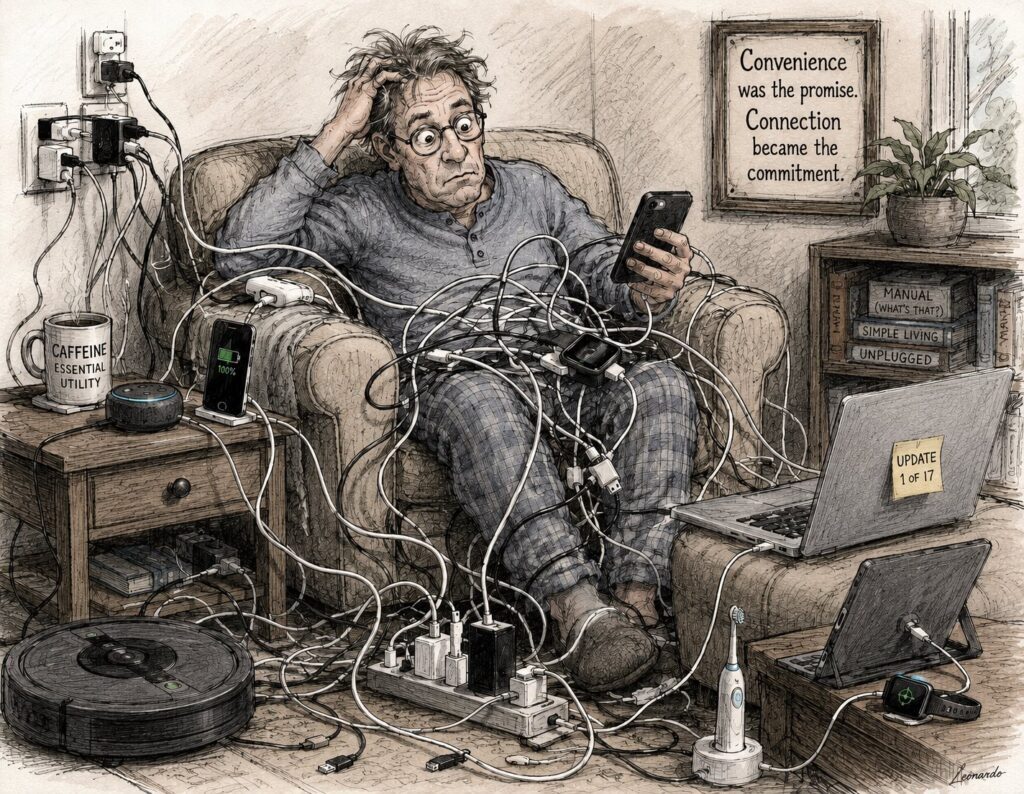
While there has yet to have been an organized mass tossing of infuriating devices into the Boston Harbor in protest, probably many of us have wanted to chuck our ornery devices out the window or against the wall in moments of sheer exasperation. And yes, there are some signs of a new trend of a rebuke of technology and if things continue, that great day of reckoning may not be too far over the verizon.
There indeed appears to be a growing cultural shift toward intentionally less technology. People are embracing printed books, film cameras, handwritten letters, record players, and simpler devices—not because they’re anti-tech, but because they’re tired of every experience requiring a screen, an app, or an algorithm. Recent reporting also points to renewed interest in older devices like the iPod Shuffle precisely because it doesn’t do everything. You can read more about this trend in a recent TechCrunch article entitled ‘The smartphone era created an attention crisis — slow tech is fixing it.’ There may still be a place in this world, and not only for nostalgia’s sake, for MP3 players, dumb phones, printed maps, physical buttons, mechanical watches and vinyl records.
The impetus for this societal reversal is obvious—because a technological speed-bump is needed. Everyone has experienced the joy of wrestling with a “smart” device that made a simple task harder. For example, a mandatory app for simple purchases or to attend an event. Smart appliances that require accounts. Self-checkout replacing human interaction. Password proliferation. Two-factor authentication for trivial tasks. Software subscriptions replacing ownership. Televisions that require a lengthy update before you can actually relax and watch something. On and on it seems to go.
SMART: From enticement to warning.
The fact that the following hypothetical situation does not now seem implausible is, itself, an indicator of how far we’ve trodden down this road. Not far beyond the land of social media censors and thought-police, there lies an unhappy and trying little community where devices collaborate and monitor one’s every move. You decide to vent a little and write a post about the advance of the digital beasts and your smart watch senses a slight rise in blood pressure and increased perspiration which it then communicates to your smart keyboard. This keyboard also picks up on the fact that you are applying more than the average pressure to your keystrokes and suddenly these keystrokes stop producing the signals that result in an output of information and you then receive a popup message on your screen asking you to reply to a short list of standardized questions and short of the correct answers you find yourself locked out of proceeding with your writing. Imagine every facet of your life being controlled in a similar manner, thirty minutes here and thirty minutes there; all being involuntarily surrendered to the increased awareness of the apparatuses of precrime monitoring which might soon reside in everything prefaced as smart. Maybe not so clever of us… What is worrisome is that when the proliferation of this technology advances to a certain point, the smart label will undoubtedly be removed due to redundancy and then, like the harmful additives lurking within the increasingly long list of ingredients that we find on our food, avoiding these kinds of devices will require much more effort.
The smart devices are coming, the smart devices are coming…
The preceding scenario is already becoming a much more horrifying reality, and before you accuse Mikey of having spent too much time reading science fiction paperbacks by flashlight, let’s consider the following. As of late there have been a flurry of social media posts and news articles centered around Ford Motor Co. patents and what possibly lies in store for us when we hop into our cars. Recently, Ford has filed patents involving everything from biometric monitoring to in-cabin advertising and driver surveillance. Whether every patent becomes a product is another question entirely, but the direction is enough to make one wonder whether “smart” has begun to mean something rather different than it once did.
The information which follows was posted as part of a YouTube presentation by the channel @LoyalMoses:
The War on Independence is an ongoing series covering legislative threats, corporate overreach, and the fight to own what you buy.
- Ford Lip Reading Patent (20260095520)
- Ford In-Cabin Biometrics Patent (20250258278)
- Ford Criminal Record Patent
- Ford Ad-Listening Patent (US-20240289844-A1)
Here is the related video:
It’s Not Your Truck Anymore. They Won. — LoyalMoses
Readers interested in exploring these patents can easily find them online by those names.
They are also linked on the aforementioned YouTube presentation.
Woe unto those who seek only comfort…
So, whether you’ve just had an argument with your spouse and need to get away, or if there has been an accident, or you’re simply on your way to give a speech before hundreds on behalf of your company, or any countless other possibly adrenaline-increasing activities, you might just be prevented from driving the car that you paid for with your hard-earned dollars. The wise Ben Franklin had a few words to say about such matters…
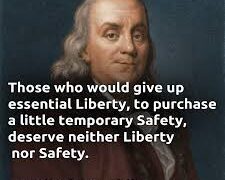
This feels eerily similar to the so-called ‘vaccine mandates’ and ‘vaccine passports’ that were trial-ballooned during the episode—call it what you will—that occurred as this latest decade was ushered in. Ford Motor Co., now, according to the preceding information, joins the growing legion of ethically trainwrecked corporations, which obviously have no qualms about trying to force their wares on—and in some dubious cases, in—all of us. Somewhat discouraging is the fact that if one does a quick online search, it appears that the momentum has not significantly slowed and continues marching brazenly on toward what George Orwell and Ray Bradbury may have been trying to warn us about. At least these devices have yet to demand that we bend the knee or kiss the ring, but how certain can we be that those days are not approaching? Here is a small fraction of what Mikey found with a quick search of the term “smart appliances:”
Top Smart Appliance Categories (Mikey’s showing only one here)
- Refrigerators: High-end models like the [Samsung 4-Door Flex](homedepot.com Hub-Plus/329583905)
feature touchscreens, internal cameras to scan ingredients, and Beverage Centers.
And here’s some of the touted benefits:
Key Benefits
- Energy Efficiency: You can schedule heavy-draw appliances, like dishwashers and dryers, to run
during off-peak hours, potentially lowering your electric bills. - Maintenance Monitoring: Smart systems warn you of upcoming issues—such as a clogged vent
or a failing filter—before a breakdown occurs. - Peace of Mind: Receive mobile notifications if your refrigerator door is left open or if a wash cycle finishes.
Sounds great, right? And how, after all, did we ever navigate life without these all-important necessities? Remembering history, the Trojan Horse arrived appearing as a beautiful gift. Do we unquestioningly welcome what may be a modern-day Trojan Horse, or do we pause long enough to ask what it might be carrying? Perhaps it’s merely coincidence that the lifeblood of technocracy necessarily flows through the veins of a world increasingly saturated in technology.
Without being naïve, we should not envision the doom and gloom of a dystopian nightmare—if our world is truly created by our imagination and thoughts—but rather approach the situation with logic and reason. At the same time, we must demand that our inalienable rights are preserved, especially when it relates to our purchases and the things that we bring into our lives. Exactly how we do this Mikey does not propose to answer, but he does confidently suggest that we should at least consider putting in the effort to win these battles before they have the potential to organize into an all-out war. The optimistic words of one of the songs by the band RUSH come to mind (if only ethics ruled, instead of the almighty dollar):
“And the men who hold high places
Must be the ones who start
To mold a new reality
Closer to the heart…”
Technology has given us remarkable tools. The danger isn’t that they’re becoming smarter. The danger is that we may someday forget that they are our servants rather than our masters—it irks Mikey every time that the car refuses to shut up until he has put on his seatbelt, or at least pretended to. In the meantime, Mikey plans to continue enjoying books that don’t require firmware updates, stereos with actual knobs, and refrigerators whose greatest ambition is simply to keep the milk cold.
This has been Mikey’s midnight ride…