Only in a world run, controlled and dominated by fractional reserve banksters could owing money to another man, or to an institution, be made to seem advantageous. Think about it…
That is not to say that there might not be superior strategies to arriving at zero debt. Nor does Mikey maintain that there aren’t certain financial nuances at play once debt has been incurred. But the idea that having a monetary liability is somehow an asset is an absurdity that could only exist in an Appearance of Reality. Do you see—liability equals asset—it? In this same realm, not by coincidence, a Federal Reserve Note—carried as a liability of the central banking system—has been knighted with the equivalency of money.
This topic, one of an endless number of twisting and turning rabbit trails jutting off from the primary shaft, was summoned to the forefront of Mikey’s observations by a recent NYT headline which reads “The Pros and Cons of Paying Off Your Mortgage Early.” The article goes on to make its argument sound completely reasonable—but that is only when viewed from within the framework that has been built around us.
The title of the article, however, when taken at face value, reveals the Grand Illusion that the Wizards have enticed us into. Can you see it?
Are we born into a framework so ubiquitous that most of us never even realize there was anything to question?
As Mikey is often wont to ask: how did we get here? Mikey has his own decidedly non-mainstream opinions about how we arrived here, accumulated over years of reading about banking, money and the history surrounding both. He doesn’t expect to settle any of those century-old arguments today, but Mikey might say that each of us, unless the assumption is refuted, is just a legal fiction of circumstance. And as such, we unknowingly spend our entire lives in this Appearance of Reality. Within this dominion—a creation within Creation—the banksters truly reign supreme.
Most reading the article referenced above will immediately think about taxes and the so-called tax breaks that are a derivative of paying usury on promissory notes. And Mikey would counter this with—EXACTLY! Who do you think dreamed up this convoluted world of taxation we find ourselves trying hard not to drown in? Established in 1913, the Federal Reserve is another one of those brilliant government misnomers which inherently dons it with the air of authority. And, therefore, most never even think to question this so-called authority. Well-played yet again District of Criminals. The Federal Reserve grew in no small part from plans conceived by some of the era’s most powerful bankers and financiers and perhaps not coincidentally the so-called income tax was enacted that same year via the Revenue Act of 1913. This has all been debated endlessly and will not be settled here. Such things are now akin to religious beliefs and are equally difficult to get to the bottom of. The preceding was mentioned only to oppose the ridiculous premise of liability equals asset.
You might now be wondering about the phrase Appearance of Reality. On January 4, 1935, in his Annual Message to Congress, president of the United States Franklin D. Roosevelt surrealistically stated the following: “The attempt to make a distinction between recovery and reform is a narrowly conceived effort to substitute the appearance of reality for reality itself.” Make of that what you will, but Mikey is not alone in asserting that if we aren’t careful and fastidious we do find ourselves legally entangled in the intentionally cumbersome Appearance of Reality rather than in reality itself. So much of what we now accept as authentic is merely a sleight-of-hand-created illusion instead of the real thing. That fiat currency is money is one example among many and, in fact, is the foundation of shifting sand upon which this house of cards—the Appearance of Reality—is built.
Many have said that the Federal Reserve is not federal and that it has no reserves. The federal aspect certainly is tricky, as it is a hybridized organization, but the question of exactly what backs its currency is perhaps more interesting. Mikey went looking for what stood behind the IOU and discovered, among other things, an awful lot of…more debt. And since the fiat currency that the Federal Reserve supplies has not been redeemable in gold for half a century, Mikey wonders what the average person imagines those “reserves” to be anyway. Perhaps a warehouse full of printing machines, giant rolls of paper and numerous barrels of ink?
Rather than repeat or try to add to all that has been said about these important and legally overwhelming subjects over the last century, Mikey will simply point towards some of the intriguing evidence and interpretations he tends to agree with. Foremost among these is Eustace Mullins’ The Secrets of the Federal Reserve and another particularly interesting rabbit hole leads to the supposed monetary symbolism embedded in L. Frank Baum’s The Wizard of Oz. Whether Baum intended any of it is another argument for another day, but once you’ve followed the Yellow Brick Road this far, it’s awfully difficult not to notice what it’s paved with. Debt instruments and words of art and legal fictions, oh my! The rabbit trails multiply almost without end. Are we born into a framework so ubiquitous that most of us never even realize there was anything to question? This subject is virtually inexhaustible—which any Appearance of Reality worth its weight in deception probably ought to be—and Mikey sincerely hopes that this post might spur some investigative curiosity.
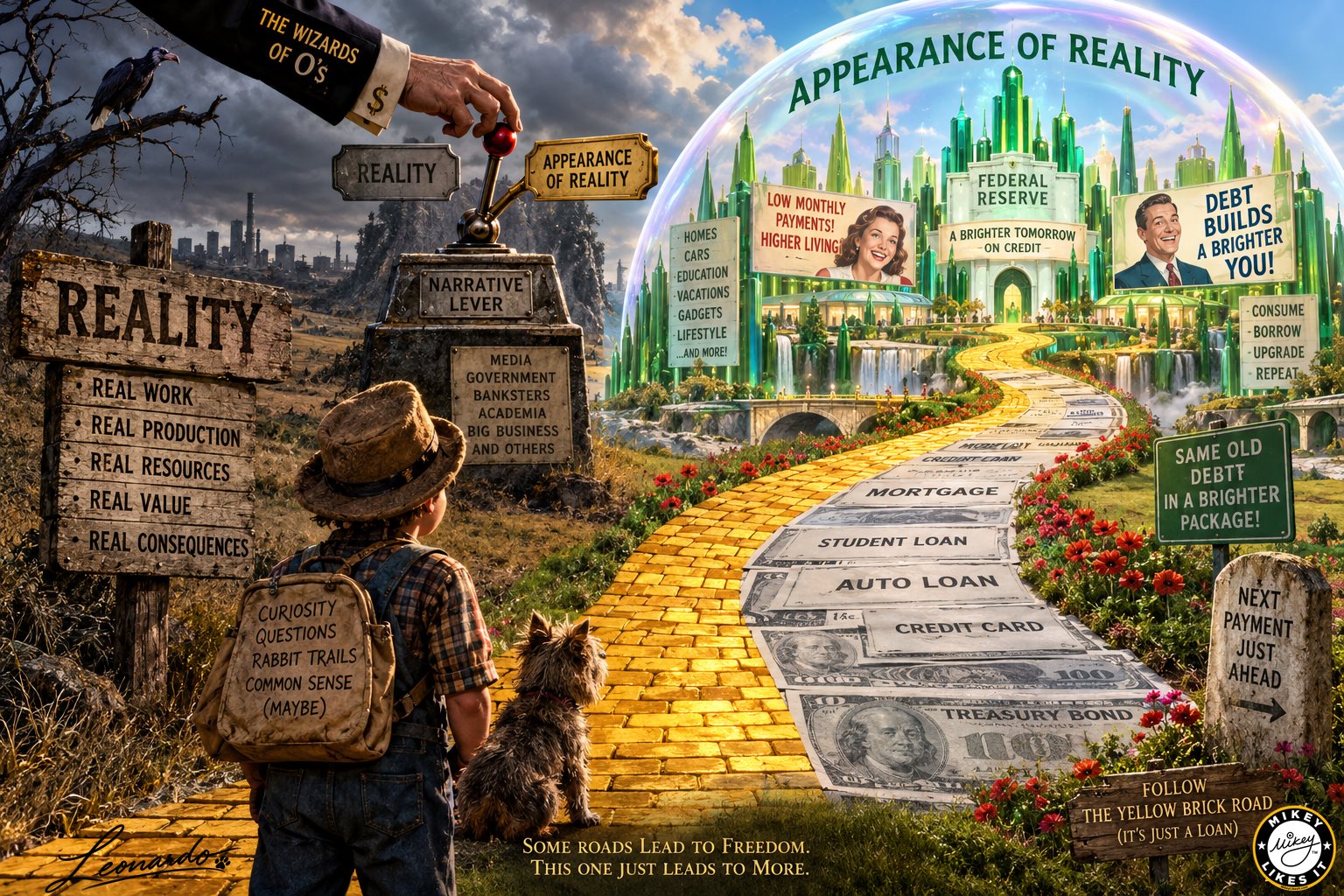
If all of this seems complex, just remember that your liability doesn’t magically become your asset merely because the framework has found ways to make keeping it advantageous. Whenever Mikey encounters the suggestion that remaining indebted may somehow be preferable to eliminating the debt, he now treats it as a dream signal—a little nudge toward lucidity and a reminder to ask whether he’s standing on the land of reality or levitated above the land within its mesmerizing facsimile.
As the eloquent and keenly perceptive Cartman might say to all this: “What what in the butt?”